• July 16, 2026
  • Updated 8:12 pm
Back
SEARCH AND PRESS ENTER
Recent Posts
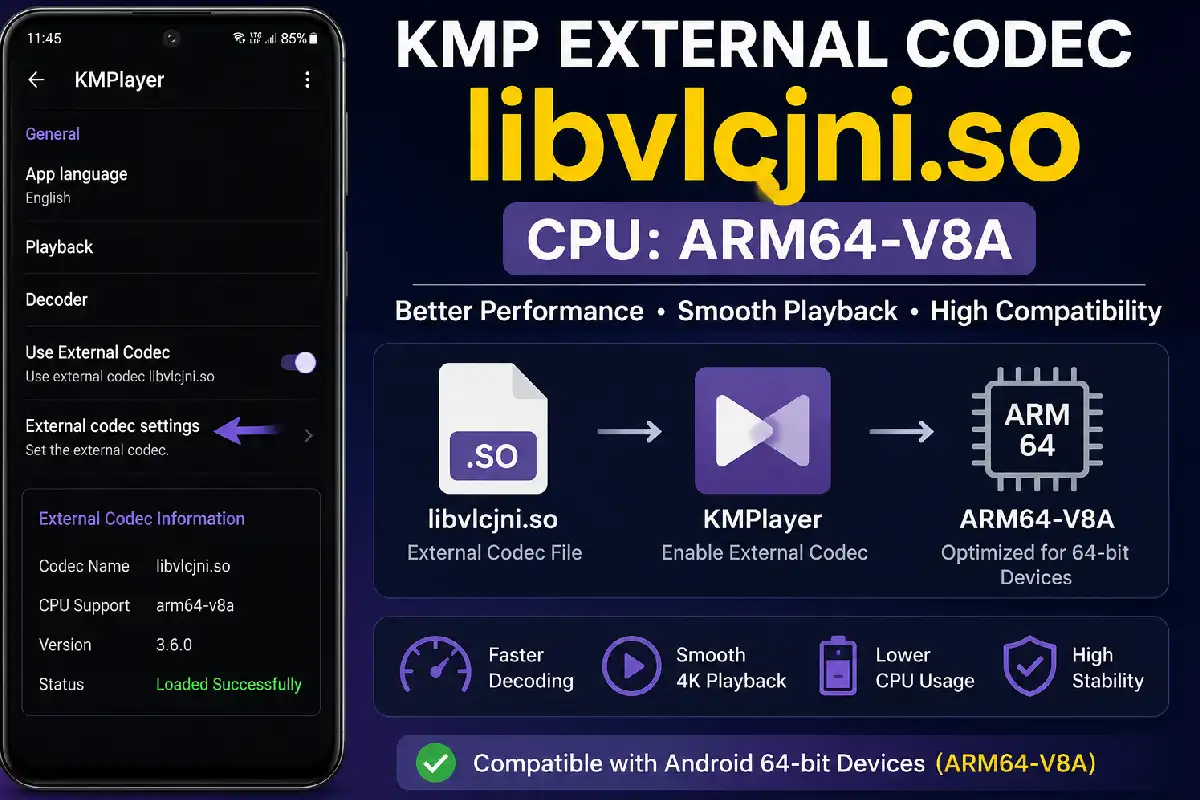
KMP External Codec libvlcjni.so CPU ARM64-v8a: Complete Setup and Usage Guide

The most common keywords for Android phone owners when dealing with playing unsupported media files in the KMPlayer media player are KMP External Codec, libvlcjni. so, CPU arm64-v8a. These keywords appear since there are media players that possess built-in codecs, but they cannot decode certain files; therefore, it becomes necessary to seek out external compatible codec packages with regard to the CPU architecture.

Libvlcjni. so is associated with the VLC media library. It might be either a part of the Android apps or external codecs in order to enable additional multimedia format support capabilities. Arm64-v8a refers to a type of processor architecture utilized in some Android phones.

This paper gives information on the concept of KMP External Codec libvlcjni.so CPU arm64-v8a, external codecs operation, installation problems, requirements for compatibility, and tips on handling external codecs on Android devices.

What Is KMPlayer?

KMPlayer, also known as KMP, is a famous media player available on Android, Windows, and other systems. It supports different video and audio formats, and its features include:

  • High-definition video playback
  • Subtitle support
  • Playback speed controls
  • Background audio playback
  • Gesture controls
  • Playlist management
  • Chromecast support (on supported versions)
  • Hardware acceleration

What Is an External Codec?

A codec (coder-decoder) is software that compresses and decompresses digital media.

An external codec is an additional component installed separately from the media player to enable playback of formats that are not supported by the default installation.

External codecs can help with:

  • Rare video formats
  • High-efficiency compression standards
  • Older multimedia formats
  • Advanced audio codecs
  • Device-specific decoding.

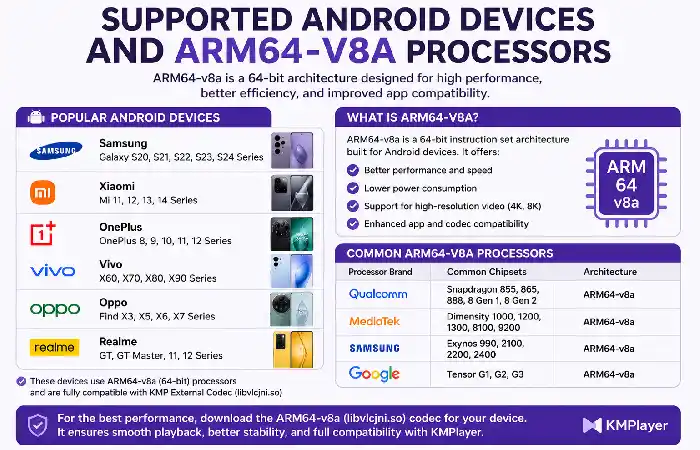
Supported Android Devices and ARM64-v8a Processors

arm64-v8a supported android

Here, we will learn about the Android devices that are compatible with the ARM64-v8a architecture, since the KMP External Codec for libvlcjni. So supports this architecture. In other words, most of the current Android smartphones and tablets come with an ARM64-v8a processor, giving rise to better performance, better memory management, and smooth playback of videos with high resolution.

Device Category Common Processor Series ARM64-v8a Support Compatibility with libvlcjni. so
Samsung Galaxy Devices Exynos 2100, Snapdragon 8 Series Yes Fully Supported
Google Pixel Devices Tensor Series, Snapdragon Series Yes Fully Supported
OnePlus Smartphones Snapdragon 7 and 8 Series Yes Fully Supported
Xiaomi and Redmi Devices Snapdragon and MediaTek Dimensity Yes Fully Supported
Vivo and OPPO Phones Dimensity and Snapdragon Processors Yes Fully Supported
Older Android Phones ARMv7 Processors No Requires Different Codec Version

Understanding libvlcjni. so

The file libvlcjni. It is a shared library used by applications that integrate VLC’s media framework.

Breaking down the name:

Component Meaning
lib Library file
VLC VLC media framework
JNI Java Native Interface
.so Shared Object file used on Android/Linux

What does CPU arm64-v8a mean?

Android applications are built for different processor architectures.

The arm64-v8a architecture is the standard 64-bit ARM platform used in most modern smartphones and tablets.

Common Android CPU Architectures

Architecture Device Type
arm64-v8a Modern 64-bit Android devices
armeabi-v7a Older 32-bit ARM devices
x86 Intel Android devices
x86_64 64-bit Intel devices

Why does KMP use the external codec libvlcjni? So CPU arm64-v8a requests an External Codec

KMPlayer may prompt for an external codec in situations such as:

Unsupported Video Format

Some files use codecs not included in the default player.

Unsupported Audio Codec

The video may play, but audio cannot be decoded without additional support.

Hardware Decoder Limitations

Certain devices cannot decode specific formats using built-in hardware.

Advanced Compression

Newer compression technologies may require updated codec libraries.

Supported Multimedia Formats

With appropriate codec support, media players can handle formats such as:

Video

  • MP4
  • MKV
  • AVI
  • MOV
  • FLV
  • WMV
  • MPEG
  • WebM

Audio

  • MP3
  • AAC
  • FLAC
  • WAV
  • OGG
  • AC3
  • DTS (where supported)

Actual support depends on the player, Android version, and installed codecs.

Benefits of KMP external codec libvlcjni. So CPU arm64-v8a

Installing compatible codecs can provide several advantages.

Improved Compatibility

More video and audio formats become playable.

Better Playback Quality

Proper decoding may improve synchronization and stability.

Enhanced Performance

Optimized codec libraries can reduce playback issues on supported hardware.

Support for High-Resolution Content

Some codecs improve compatibility with HD and 4K media files.

How to Check Your Device Architecture

Before installing any codec package, verify your device’s processor architecture.

You can:

  1. Review your device specifications.
  2. Check the CPU information in your phone settings (if available).
  3. Use a trusted hardware information app.
  4. Refer to the manufacturer’s documentation.

Installing a codec for the wrong architecture may result in errors or a failed installation.

Installing an External Codec

If a compatible external codec is required:

Step 1

Download the codec only from trusted and reputable sources.

Step 2

Ensure the codec matches your CPU architecture (for example, arm64-v8a).

Step 3

Follow the media player’s instructions for adding or recognizing the codec.

Step 4

Restart the application if necessary.

Common Errors Related to libvlcjni. So and Their Solutions

The user might sometimes come across errors concerning libvlcjni.so when running KMPlayer external codecs on Android devices. Incompatibility with the CPU architecture, absence of the files, or incorrect installation path of the codec is usually responsible for such problems.

libvlcjni.So Not Found

  • Either check whether you have properly installed the package of external codecs, or see if the file lies in the right KMPlayer codec folder.

Unsupported CPU Architecture

  • Determine the type of processor that your device has: ARM64-v8a, ARMv7, or x86.
  • Download the compatible codec package according to your device architecture.

Codec Failed to Load

  • Restart KMPlayer after installing the codec.
  • Redownload the external codec package if the issue has not been solved.

App Crashes While Playing Video

  • Update KMPlayer to the latest version.
  • Delete incompatible or outdated codec files from your device.

Audio Works but No Video

  • Turn on hardware acceleration in KMPlayer settings.
  • Download the latest optimized ARM64-v8a codec package.

Permission denied

  • Grant KMPlayer storage permission.
  • Makes sure that KMPlayer can reach the codec files on the device.

Troubleshooting Playback Problems

When the media does not work properly:

  • Relaunch the application.
  • Update KMPlayer to its most recent version.
  • Make sure that the codec corresponds to the architecture of your device.
  • Try playing a different media file.
  • Clean the application’s cache if required.
  • Relaunch your Android device.

If no result is obtained, the file might not be supported or corrupted.

Security Issues

As the shared library files may run the native code, it is necessary to download them from trustworthy sources.

How to enhance security:

  • Download files only from trustworthy websites.
  • Dissuade from downloading altered or unverified codec packages.
  • Maintain up-to-date Android security updates.
  • Install antivirus if possible.
  • Do not allow extra permissions to unknown applications.

KMPlayer vs Other Media Players

Feature KMPlayer Typical Media Players
External Codec Support Yes Varies
Subtitle Support Yes Usually
Gesture Controls Yes Varies
Hardware Acceleration Yes Yes
High-Resolution Playback Yes Depends on the player
Multiple Format Support Extensive Varies

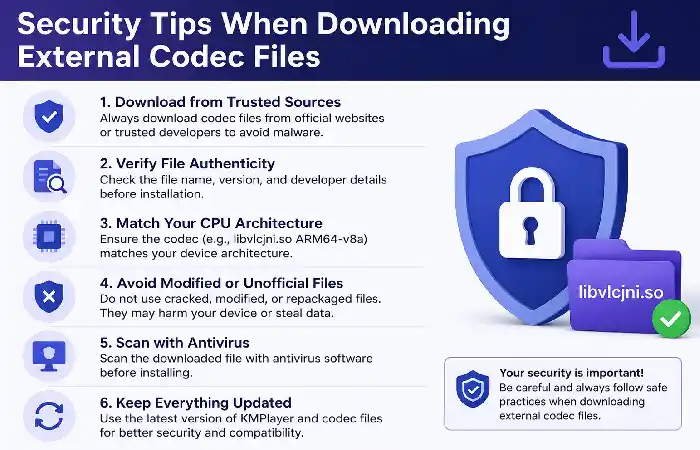
Security Tips When Downloading External Codec Files

security tips when downloading

Downloading external codec files from credible sources will help avoid cases of malware infection and corruption, in addition to other problems in the system. Make sure to verify the version and the CPU architecture of the file before downloading.

  • Download codec files from credible sources only.
  • Make sure that the codec is compatible with the CPU architecture of the device.
  • Avoid using modified APK files.
  • Sweep the file for viruses.
  • Update KMPlayer and the codecs.

Performance Improvements with ARM64-v8a Optimized Codecs

The kmp external codec libvlcjni.so cpu arm64-v8a optimized codecs have improved the video decoding process in the current Android mobile devices, such as smartphones and tablets. They are built in such a way that they exploit the features of 64-bit processors to reduce the processing workload of the CPU and improve battery efficiency while supporting Full HD and 4K video files.

Feature Standard Codec ARM64-v8a Optimized Codec
Video Decoding Speed Moderate Faster
CPU Usage Higher Lower
Battery Consumption More Reduced
4K Video Playback Limited Performance Optimized Performance
App Stability Standard Improved
Hardware Acceleration Support Partial Enhanced

Frequently Asked Questions

What is libvlcjni?

It is the name of a native shared library concerning the VLC media player framework, and it allows Android applications to perform multimedia decoding and playback.

What does arm64-v8a refer to?

It is the name of the 64-bit architecture of ARM processors that is common for most Android smartphones nowadays.

Why does KMPlayer require external codecs?

Some external codecs are necessary for KMPlayer in order to decode specific video/audio that cannot be decoded by means of internal codec tools.

Is there an opportunity to install some codecs on my device?

No, you may install only those codecs that fit your application requirements and CPU architecture.

Is it safe to download codec files?

It can be safe if you download the codecs from trusted sources. You should never install modified codec files.

Best practices

The following best practices should be followed when managing external codecs:

  • Use the most reputable sources for downloading a codec.
  • Ensure that the codec is suitable for your CPU architecture.
  • Ensure that your media player is updated.
  • Never forget to back up your data before making any changes.
  • Never change system files manually.

Conclusion

“KMP External Codec libvlcjni.so CPU arm64-v8a” is generally the title of the codec that is capable of being used along with KMPlayer on an Android device with an ARM 64-bit processor. If they happen to be appropriate enough to use on your device and media player, then they would help you play different kinds of audio and video files.

While using these codecs, you need to make sure that your device architecture is compatible and from reliable sources only.

Hi, I’m Sameena Fatima, the creator behind TargetTacticsWeb. I share practical strategies, smart tactics, and real-world insights to help you grow in business, marketing, and digital spaces. My goal is simple: to make complex strategies easy and help you take clear, confident action toward your goals.